Corner openings in tic tac toe, search patterns in Battleship
The quickest route to a tic tac toe win is to open in a corner and wait for one mistake. After a corner opening, your opponent has exactly one safe reply: the centre. Anything else lets you threaten two lines at once within three moves. Against a player who never slips, tic tac toe always ends in a draw, so the real skill is punishing errors. Battleship, the other classic from the back of the school notebook, rewards the same thinking: the winner searches the grid with a pattern instead of firing at random.
Tic tac toe rules, step by step
- The board is three by three, nine squares in total. One player uses X, the other O.
- You take turns placing your mark in an empty square. You can never write over a filled one.
- Whoever lines up three of their own marks across, down or diagonally wins the game. There are eight winning lines: three rows, three columns and two diagonals.
- If all nine squares fill without a line, it is a draw. In Britain the game is called noughts and crosses; same rules.
Moving first is an advantage, so agree on who plays X. Some families swap every game, others let the loser start. If nobody can agree, a quick round of Roshambo decides it.
Number the squares like a phone keypad
To talk about moves, number the squares the way a phone keypad does: top row 1-2-3, middle row 4-5-6, bottom row 7-8-9. Corners are 1, 3, 7 and 9, edges are 2, 4, 6 and 8, and 5 is the centre. The centre sits on four lines, each corner on three and each edge on only two. That is why edge squares are the weakest spots on the board.
The corner opening: punish the mistake
As X, play square 1. Everything now depends on O's answer.
If O takes an edge
Say O plays 2. You take the centre, 5, which threatens the 1-5-9 diagonal, so O is forced to block at 9. Now play 7. You have two threats at the same time: square 4 finishes the 1-4-7 column and square 3 finishes the 3-5-7 diagonal. O can only block one of them, and you win with the other. A move that threatens two lines at once is called a fork, and every tic tac toe win comes from one.
If O takes the opposite corner
If O answers at 9, take 3. The top row is now under threat, so O must play 2. Then drop your X on 7: square 4 wins the left column and square 5 wins the diagonal. Another fork, another win.
If O takes the centre
This is the correct reply, and accurate play from here draws. One trap remains: play the opposite corner, 9. If O now takes a corner, say 3, they threaten 3-5-7, and when you block at 7 you create threats at 4 and 8 at once. O's only escape is an edge square. Because the edge feels wrong, plenty of players lose exactly here.
How to hold a draw as O
When you move second, your first job is not to lose. A short set of rules covers almost everything:
- If X opens in a corner, take the centre. Any other answer can lose.
- If X opens in the centre, take a corner. An edge reply hands X a fork.
- Before every move, scan for two X marks on an open line. If there is one, drop your plan and block it.
- If X holds two opposite corners and you hold the centre, your next move goes on an edge.
Battleship rules
In Battleship each player has a grid and hides a fleet on it. Ships sit horizontally or vertically, never diagonally. You take turns calling a square on the other grid; if a ship is there it is a hit, otherwise a miss. When every square of a ship has been hit, that ship is sunk, and the first player to lose the whole fleet loses the game.
Fleet sizes vary. The boxed version most people know uses ships two to five squares long, paper versions often use smaller boats, and some tables forbid ships from touching. In Maritime Conflict you search the grid yourself, shots alternate, and the game tracks hits and misses.
The search pattern: fire like a checkerboard
Every Battleship strategy splits into two modes: hunting and finishing. While hunting, you have not hit anything yet, and you want to find a ship in as few shots as possible. The trick is to picture the grid as a checkerboard and fire at one colour only. If the smallest ship is two squares long, it has to cover one square of each colour wherever it sits, so you can catch the whole fleet while skipping half the board.
Once the smallest ship is gone, widen the gap. If the shortest ship left is three squares, firing at every third square is enough. Edge and corner squares are covered by fewer possible ship positions, so aiming at the middle first tends to shorten the hunt.
After a hit: finishing mode
The moment you score a hit, drop the pattern. Try the four neighbours of that square one by one; diagonal neighbours are wasted shots because ships never sit diagonally. A second hit tells you the direction, so keep firing along that line in both directions. When the ship sinks and your table uses the no-touching rule, cross out the squares around it as well and go back to the hunting pattern.
Common mistakes
- Opening tic tac toe on an edge. It still draws, but it gives your opponent far fewer ways to go wrong.
- Chasing your own line and missing the opponent's pair. More games are lost this way than any other.
- Firing somewhere new after a hit in Battleship. A half-found ship is the cheapest target on the board.
Where to practise
A tic tac toe game takes seconds, so replaying the same opening ten times in a row is the easiest way to learn it.
tictactoe has a clean board and two players take turns on the same screen. It is the simplest place to walk through the three cases above with a friend. On a phone you just tap the squares.

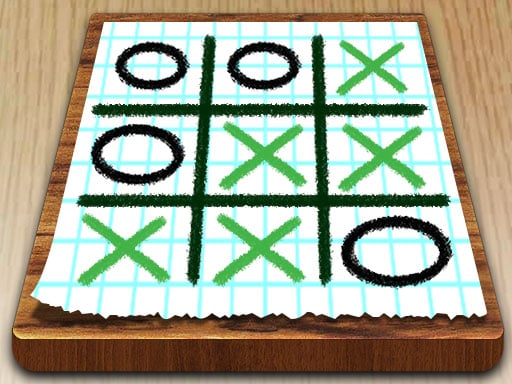
Tic Tac Toe: Paper Note looks like a squared notebook, and picking the one-player mode from the menu puts the computer on the other side. Good for drilling the O defence when nobody is around.
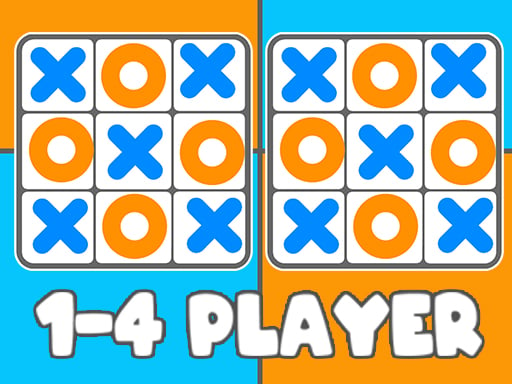
Tic Tac Toe 1-4 Player lets up to four people take turns on one device. With more players, defence matters even more, because you are watching several opponents' lines at once.
Maritime Conflict is where you try the checkerboard pattern and finishing mode. Click with the mouse or tap the screen to pick a square and fire.

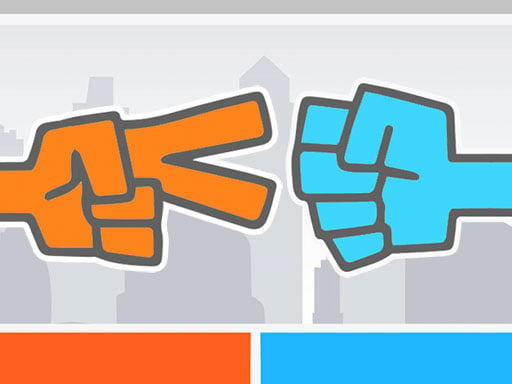
In Roshambo's two-player mode the first player uses A, S and D and the second uses J, K and L; first to three points wins. A fast way to decide who gets X.
You will find more grids in the board games category and among the 2 player games. For the bigger picture, read the board and card games guide, and when you are ready for a deeper game, the chess and checkers guide for beginners.
FAQ
Is there a way to always win tic tac toe?
No. If both players play correctly, every game is a draw. The corner opening only raises the chance that your opponent makes a mistake; when they do, a fork wins it.
Should the first move go in the centre or a corner?
Neither loses. The centre feels safer because it sits on four lines; a corner gives your opponent more ways to answer badly, so it creates more winning chances.
Can ships touch each other in Battleship?
It depends on the table. Agree before you start, because it decides whether you can cross out the squares around a sunk ship.
Is the opponent in Maritime Conflict a real person?
No. Matches are single-player and turn-based: you fire, then the other side makes its move.