Chess and checkers rules: piece moves, castling, forced jumps, early traps
Chess is played by two people on an 8x8 board, each with 16 pieces, and there is only one way to win: attack the enemy king so that it has no safe square left. That is checkmate. White always moves first and then you alternate, one move each. Checkers uses the same size of board but far fewer rules: you win by capturing all of your opponent's pieces or by leaving them with no legal move. Chess rules come first, then checkers, then the opening traps.
Setting up the board
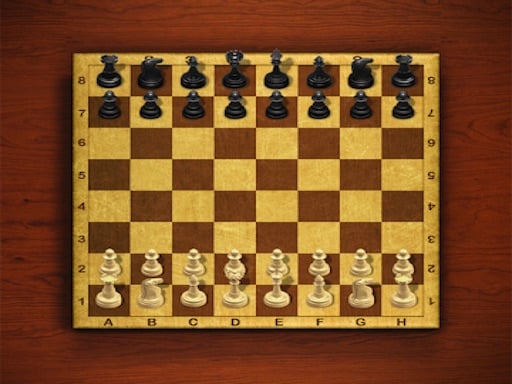
Turn the board so that the square in your bottom right corner is a light one. Your eight pawns go on the second row. On the first row, rooks take the corners, knights stand next to them and bishops come next. The last two squares in the middle belong to the queen and king. Memory trick: the queen goes on her own color. Black mirrors the same setup on the far side.
How the chess pieces move
- King: One square in any direction. It can never step onto a square that is under attack.
- Queen: Any number of squares in a straight line or diagonally. The strongest piece on the board.
- Rook: Straight lines only, forward, back or sideways, as far as the path is clear.
- Bishop: Diagonals only, which means it stays on the same color for the whole game.
- Knight: Moves in an L shape, two squares straight and one to the side. It is the only piece that can jump over others.
- Pawn: One square forward, or two on its very first move. It never moves backwards and, oddly, it captures diagonally even though it walks straight.
To capture, you move onto the square of an enemy piece; it leaves the board and your piece takes its place. You cannot land on or pass through your own pieces, the knight being the exception.
Special rules: castling, en passant and promotion
Castling
Castling is the only move where two pieces move at once. The king slides two squares toward a rook, and that rook hops over to the square right next to it. Castling kingside uses the short side of the board, castling queenside the long side. Four conditions apply: neither the king nor that rook has moved yet, there is nothing between them, the king is not in check right now, and the king does not cross or land on an attacked square. Aim to castle within your first ten moves.
En passant
If an enemy pawn uses its double first step and lands right beside your pawn, you may capture it as if it had moved only one square. You have to do it immediately on your next move; wait a turn and the chance is gone. It is an official rule, not an app bug.
Promotion
A pawn that reaches the last row turns into a queen, rook, bishop or knight. You will nearly always pick a queen, even if you already have one.
Check, checkmate and stalemate
When your king is attacked, you are in check, and your next move must fix it: move the king, block, or capture the attacker. If none of the three works, it is checkmate and the game is over. Stalemate is something else: it is your turn, your king is not attacked, yet you have no legal move at all. Stalemate is a draw. Grabbing every last pawn while far ahead is the classic way to stumble into it.
Checkers rules: two families of the game
In the US and the UK, checkers (draughts) means the diagonal game. Each side has 12 pieces on the dark squares of the first three rows. Pieces step one square diagonally forward and capture by jumping onto the empty square behind an enemy piece. A piece that reaches the far row is crowned king and can then move backwards too. On the continent, international draughts follows the same idea on a 10x10 board with 20 pieces per side, and kings there can fly across the whole diagonal.
Our Checkers Legend belongs to this diagonal family: pieces go diagonally forward, a crowned piece can move backwards, and you pick the rule variant in the settings. For contrast, the game Turks call dama moves in straight lines instead. There, 16 pieces per side start on the second and third rows, move one square forward or sideways and capture orthogonally, and a crowned piece slides along a whole row or column like a rook.
The forced capture rule
This is the big difference from chess: if you can capture, you must. In international draughts you also have to choose the sequence that takes the most pieces. Old English club players used to punish a missed jump by removing the offending piece, a custom called huffing; modern rules dropped it, but some kitchen tables still play it. That turns checkers into a game of bait: offer one piece, and after the forced jump you take two or three back. In Checkers Legend, when strict capturing is on, never leave your opponent a lane for a multi-jump.
Example: the game that ends in four moves
The mate beginners fall for most often is the four-move Scholar's Mate. White plays the pawn to e4, the bishop to c4 and the queen to h5. If Black ignores it, the queen takes the pawn on f7, backed by the bishop, and it is checkmate. At the start only the king guards f7. The defense is simple: when the queen lands on h5, push g6 to hit it, or bring your queen to e7 to cover f7. Chasing the queen with the knight to f6 is exactly the move that allows mate. Try it once in Master Chess with two players on one device.
Mistakes in the first 10 moves
- Bringing the queen out early: Enemy knights and bishops develop with tempo while she runs away.
- Moving the same piece again and again: Get each piece out once before you start a tour with one of them.
- Opening with the edge pawns: Pushing the a and h pawns hands the center to your opponent.
- Delaying castling: A king stuck in the middle gets hit as soon as the center opens.
- Leaving pieces loose: After every move, ask what your opponent can take right now.
- In checkers, emptying your back row: Those pieces are the last wall stopping enemy kings.
- In checkers, running with a lone piece: An unsupported piece is an easy jump for your opponent.
Which game to practice with
Chess 3D does exactly that: select a piece and its legal squares light up, castling and promotion work as usual, and you play alone against a computer opponent.

Once the moves feel natural, switch to Master Chess. Start on the easiest of its three difficulty levels and step up after you beat the computer a few times. Two players can also share one screen, and on a phone you tap the piece, then the square.
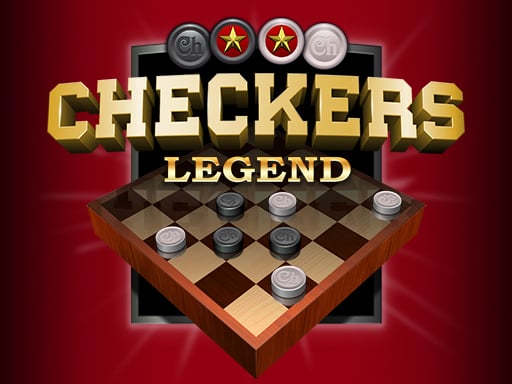
For checkers, Checkers Legend is a solid first stop. You choose the rule variant in the settings, and that choice decides how strict the capturing is. Play against the computer or a friend beside you.
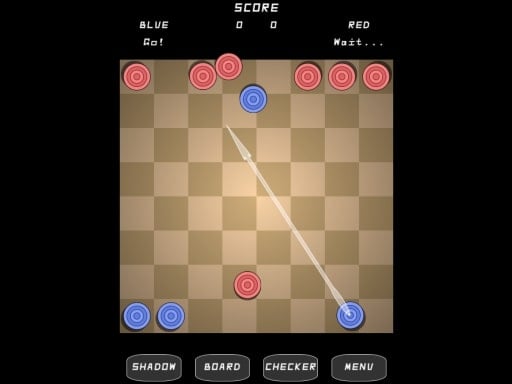
When your head is full of rules, Angry Checkers makes a good break. There are no squares to step on: you pull a disc back, aim and flick your opponent's pieces off the board. It will not train real checkers technique, but it rewards keeping your pieces grouped.
Looking for other board games? Our board and card games guide covers the wider family, and the strategy games guide is the place for slower, think-first games. The full list lives on the board games page.
Frequently asked questions
Can the king ever be captured?
No. The game ends at checkmate, the moment the king cannot escape. A move that leaves your own king under attack is illegal anyway, so a king is never actually taken.
Can checkers pieces move backwards?
Ordinary pieces cannot move backwards. That freedom arrives only once a piece is crowned. The one twist: in international draughts, ordinary pieces may capture backwards, even though they still only move forward.
Should I learn chess or checkers first?
Checkers, usually. Its rules fit on one page, while chess has six piece types and special moves, so checkers is the gentler first step for a child.