Short, thick or closed? Getting the line right in drawing puzzles
In a draw puzzle game, the right line is the shortest one that does the job. Pick one of three shapes: a short ramp or thick chunk to push or roll something, a closed shield with its ends on the ground to protect something, or a sloped channel to carry something that flows. Long, thin lines ending in mid-air usually lose, because you are drawing into physics, not onto paper. Your line has weight, it falls, it slides, and it has to take a hit.
In every game below you hold the mouse button and draw, or drag your finger on a phone. The moment you let go, the line turns into a solid object.
How drawing puzzles work, step by step
- When a level opens, read the scene. There is something to protect (a stickman, a dog), two balls to bring together, a glass to fill or a gap to cross.
- Hold the mouse button and draw; on a phone, drag your finger.
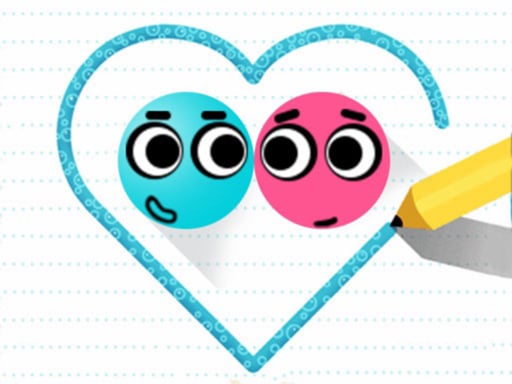
- Release, and the line becomes solid. In most games it obeys gravity: in Love Balls 2D whatever you draw gains weight and starts to fall.
- Then the action starts: bees attack, rocks drop, water pours, balls roll or a car sets off.
- Hit the goal and the level ends. Miss, and it restarts; every game here lets you try again as often as you like.
The physics of a drawn line: four rules
1. Lines fall
Love Balls 2D spells it out: a shape you draw does not hang in the air, it drops. Bump the Balls adds that long lines left floating make a level harder. Rest your line on the floor, a platform or a wall. If there is nothing to lean on, work out where it will land and leave some room above.
2. Short and thick does more than long and thin
To push something or get it moving, draw a short, thick piece instead of a long line; its weight does the work. A slanted line becomes a ramp and rolls the ball along, a thick block shoves it down. Giving the ball a first nudge is enough in many levels. Draw slightly beside the ball, though, not right under it: a line directly beneath just holds the ball in place.
3. Thickness has a limit
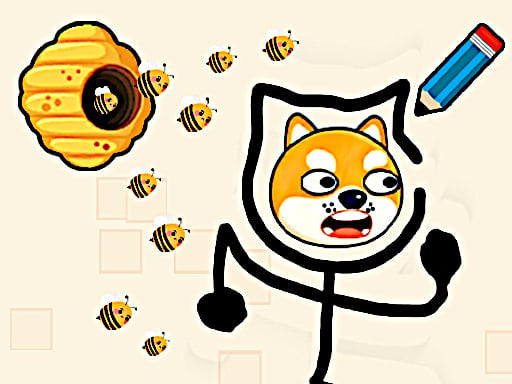
Protect My Dog explains the balance well: draw too thick and the line gets heavy and can slide to the wrong spot; draw too thin and it cannot absorb the attack. In protection levels the sturdiest shape is a sloped roof with both ends on the ground, which the game itself says holds better than a flat lid.
4. A gap means no shield
In Save My Doge bees slip through the smallest opening, and the level fails before the ten seconds are up. A half-finished circle is useless. If you close a shield, close it completely and join its ends to the ground or to each other.
Short thick line or closed shield?
It depends on what the level wants. A quick guide by scene:
- Bringing balls together: a short ramp or a thick block. Give the first push and let gravity do the rest.
- Dog and bees: a small, closed shield close to the dog. A wide circle eats ink and makes a gap more likely.
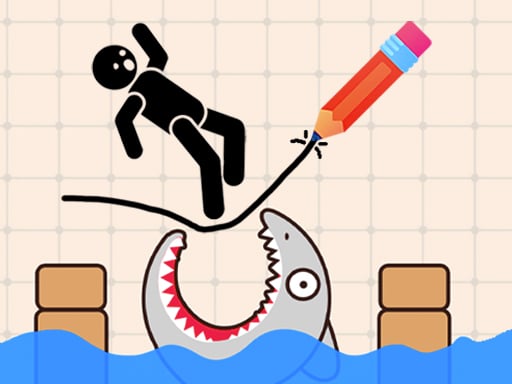
- Falling rock or arrow: in Draw and Save Stickman draw the shield a little above the stickman, not glued to him, so the impact does not knock him over. Cracks, shadows and arrow signs in the scene tell you where the danger comes from.
- Water and juice: a sloped channel. On a flat line liquid just pools, and water that drops straight into the glass splashes out.
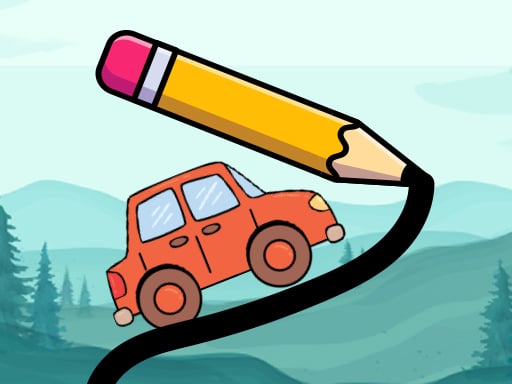
- A chasm: in Draw The Bridge one line that sits firmly on both edges, with a gentle arch over wide gaps. A bridge that starts in mid-air snaps when the car rolls on.
Worked example: a dog and bees from two directions
The dog stands on flat ground in the middle of the screen. The hive is top right; some bees fly straight down, others loop round from the left.
The obvious move is a big circle around the dog. But it closes in mid-air, tips sideways under its own weight, a gap opens and the bees get in. Half your ink went on empty space, too.
The better answer: a sloped roof just above the dog, one end on the ground at each side. Keep the side facing the hive a little higher to take hits from above. Grounded at both ends, the roof does not slide, and hugging the dog it uses far less ink. That is exactly what Protect My Dog advises: rest both ends on the ground or a platform.
Saving ink when it is limited
Ink is often limited. In Draw and Save Stickman you cannot fill the whole screen, and Save My Doge gives you only so much ink. Water Bucket and Fill Juice Glass punish extra lines by taking stars away: the fewer lines, the more stars. Four ways to save:
- Watch first, draw second. In liquid levels follow the natural path of the water. A small slope at the first point where it lands is often all you need.
- Cover the nearest danger first. With limited ink, deal with the threat closest to the dog and worry about the far one later.
- Draw in one stroke. In Draw The Bridge, overlapping broken pieces snag the car and flip it; finishing the line in one go is cleaner and sturdier.
- Learn from the failed try. Before restarting, watch where the water escaped or where the bee got in, and fix your line right there.
Common mistakes
- Lines ending in mid-air. With nothing to rest on, they drop and wreck the plan.
- A shield touching the character. The hit pushes it onto them; leave some space.
- A half shield. One gap undoes the whole drawing.
- A flat channel. Without a slope, water pools instead of flowing.
- Filling the screen. Too many lines burn ink, cost stars and tangle objects together.
Which game to practise with
An open-ended physics puzzle for seeing what a short thick piece and a ramp actually do:
The same idea with obstacles, spikes and a hint button, across a hundred levels:

The classic for reading where danger comes from and placing the shield:
Dog levels that train line thickness and the grounded roof:
Ten seconds against the bees, for closed shields and saving ink:
A water puzzle that teaches the sloped channel and rewards fewer lines:

Juice levels where one clever line earns three stars:
A bridge game that teaches a line to carry weight, with gaps that keep widening:
Where drawing puzzles sit among other logic games is covered in the puzzle games guide. For a related type built on finding the right order, see the pull the pin tips; for games about balance and precision, the skill games guide. Parents looking for cause-and-effect games can read problem solving games for kids. The full shelf is in the puzzle category.
FAQ
Do I need to be good at drawing?
No. A plain line does the job; what matters is the right spot, slope and length.
Can a level have more than one solution?
Yes. In Love Balls 2D objects move by weight and collision, so the same level can be finished with different drawings. Look for the shortest line that works rather than the one true answer.
What should I do when I am stuck?
Bump the Balls has a hint button. In the others, restart and first watch how the scene behaves; seeing once what falls where is quicker than a string of random new drawings.
Are these games fine for young kids?
Yes. Draw The Bridge and Bump the Balls are described as calm and non-violent, Save My Doge has no scary scenes, and the only action is drawing with a finger.