Onet connect explained: linking tiles with a path of two turns or fewer
Onet connect, also sold as Mahjong Connect or tile link, works like this: you pick two identical tiles and the game draws a line between them through empty squares. If that line bends at most twice, both tiles disappear. There are no stacked layers; every tile sits on one flat grid. Clear every tile and the level is done. It sounds like a small twist on mahjong solitaire, but the path rule changes how you read the whole board.
How it differs from stacked mahjong
In stacked mahjong solitaire, covered in our mahjong solitaire rules, the question is whether a single tile is free: nothing on top and one side open. In Onet no tile is free or blocked on its own. The question is always about a pair: is there an empty route that joins these two?
- Stacked mahjong has layers; Onet has a single flat grid.
- In stacked mahjong a tile depends on its neighbours; in Onet a pair depends on the route between them.
- In stacked mahjong two matching tiles side by side can still be stuck; in Onet two matching neighbours always link, because the path between them has zero turns.
To feel the difference, open two games back to back. Zoo Mahjongg Deluxe uses the classic layered rule, while Woodventure keeps the cute animal look but plays on a flat grid with the path rule.
The rules, step by step
- Click or tap a tile to select it.
- Click the second tile with the same picture. The game searches for a route through empty squares only.
- The route can be straight, bend once, or bend twice. If it needs a third turn, the match is refused.
- The route cannot pass through another tile. Until the blocking tile is gone, that pair stays put.
- In most versions the route may leave the grid and run along the empty strip around it, so tiles on the outer rows link more easily than they look.
- A valid match removes both tiles and leaves gaps. When the board is empty, the level ends.
A quick way to count turns: if you can split the route into three straight pieces or fewer, it works. One piece is a straight line, two make an L, three make a U or a Z. If you need a fourth piece, the pair is not ready yet.
Worked example: why the middle pair will not link
Say you have two matching bird tiles. One sits at the start of row three, the other in the middle of row five, and a single tile blocks the straight drop between them. Going around the right side, the line drops, turns right, drops again, then has to turn left once more. That is three turns, so it fails. The fix is not to keep clicking the birds. Find the partner of the blocking tile and clear it. Once it is gone the route shrinks to a simple L and the birds link at once.
That is the core habit of the genre: most of the time your move is not on the pair you want, but on the tile standing in its way.
Start from the edges
The single most useful tactic is working from the outer frame inward. Tiles on the outer rows face the edge of the grid, and the strip around it is usually empty. Even when two edge tiles are far apart, the line can step outside, run along the border and come back in, often without passing two turns.
- Scan the four edges for pairs first. Matching tiles on opposite sides can still connect through the outer strip.
- Each cleared edge pair turns an inner row into a new edge. You peel the board from the outside in, layer by layer.
- Take neighbouring pairs straight away. They always link, and waiting gains you nothing.
- When there are four copies of one picture, choose which two go first. Clearing the edge pair and leaving the inner two close together is usually the safer call.
- Cannot find a partner? Look at the opposite corner. On layouts like Easter Link similar patterns often repeat in mirrored spots.
Happy Fruit Link is a relaxed place to practise this: the route can loop around the outer edge, and the fruits are drawn in distinct shapes, so you can tell them apart without relying on colour.
Timers, helpers and sliding tiles
Many Onet games add a clock. Birds Connect Deluxe has fifteen levels, each with its own timer, and any seconds left at the end are added to your score. Under time pressure the edge-first habit pays off even more, because routes along the border are faster to spot than twisty ones through the middle.
When helpers are limited, timing matters. Woodventure gives you three: a hint that shows a possible pair, a bomb that blows up a random pair, and a shuffle that rearranges every tile. A shuffle can also leave the board worse, so keep it for when you truly have no moves. Using the hint to confirm you are stuck teaches you more than opening it every time you pause.
Happy Easter Links goes a step further. In some of its twenty-seven levels the remaining tiles slide down, up or sideways after each match. Here the edge tactic follows the slide direction: clear tiles towards where they slide and the board stays tidy; work against it and the gaps keep moving on you.
Common mistakes
- Starting in the middle. Routes from the centre cross the busiest area and often hit a third turn.
- Counting length instead of turns. Only bends count. A straight line across the whole board is perfectly valid.
- Forgetting the outer strip. Players try to link two edge tiles through the inside, give up, and never test the route around the outside.
- Spending the shuffle early. Shuffling while a pair still exists wastes a charge you may badly need later.
- Losing track on sliding boards. After a slide, the partner you were looking for may have moved rows. Note where both tiles sit before you click.
Which game to practise on
If the rule is new to you, first get used to seeing routes without a clock. Then move on to timed and sliding boards. The cards below run from easier to harder; the last one is a classic stacked mahjong for comparison.
 ▶Happy Fruit Link - Free Fruit Tile Link Puzzle
 ▶Woodventure - Free Forest Animal Link Puzzle
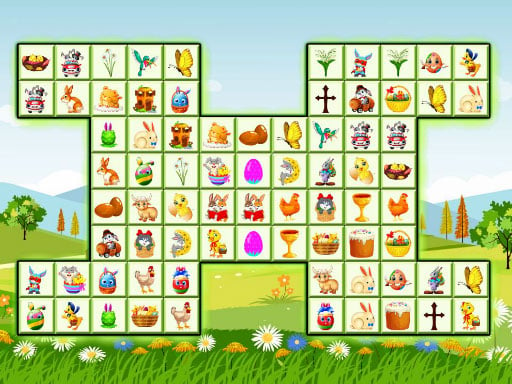 ▶Easter Link - Free Mahjong Connect Game
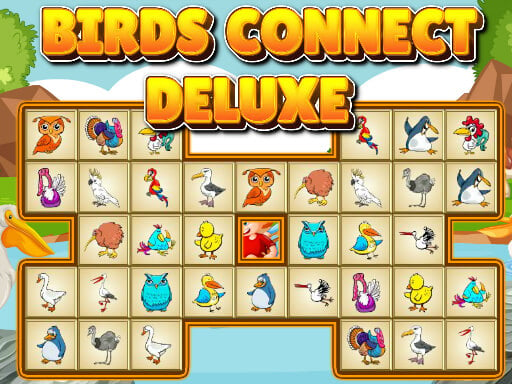 ▶Birds Connect Deluxe - Free 15 Level Tile Link
 ▶Happy Easter Links - Free 27 Level Link Puzzle
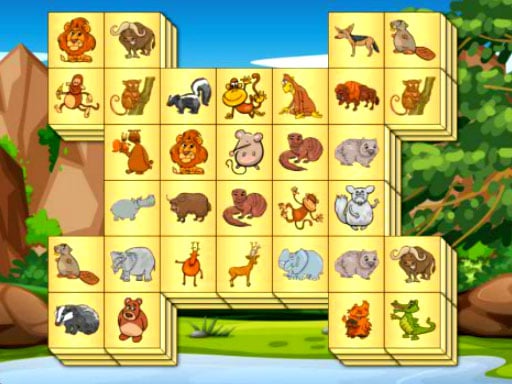 ▶Zoo Mahjongg Deluxe - Free Mahjong Game Online
For more of this style, browse our mahjong games guide, and for the rest of tile matching see board games and matching games.
FAQ
Is Onet the same as Mahjong Connect?
Yes, they are different names for the same rule. You will also see it called tile link, link-link or Shisen-style connect. In all of them, two matching tiles join through an empty route with no more than two turns.
Why is my path not accepted?
Either it needs a third turn or another tile sits on the route. Clear the blocking tile first, then come back to the same pair.
Can every board be solved?
When no moves are left, most games offer a shuffle or a restart. If shuffles are limited, treat them as a last resort; working from the edges inward usually delays a lock-up.
Does it work on a phone?
Every game in this article opens in the browser and plays on a phone by tapping the tiles. No download or sign-up needed.