Territory conquest games: take the weakest neighbour, keep the front short
The rule that wins territory war games is simple: attack your weakest neighbour, not your strongest rival, and keep the border you have to defend as short as you can. In building-link games every structure slowly produces troops or population; you open a flow from one building to another, and once your number beats the one inside the target it switches to your colour. Land grab games run the same logic with a line instead. In both, the mistakes that lose early are the same: spreading your strength thin and leaving your back door open.
Core rules: flow, numbers, colour
The genre goes by many names, but the core rules barely change. Here they are step by step, using City Takeover as the model:
- Every building produces population over time. The more buildings you hold, the faster you grow.
- Drag from your building to a target and release to start a flow; the population travels along the link.
- Empty buildings are cheap. To take an occupied rival building you must send more than the number inside it.
- A flow that falls short is wasted: the building does not change hands and the troops you sent do not come back.
- Tap an open link to cut it. It is the only way to stop a bad attack early.
- The level ends when every building on the map carries your colour.
In short, every attack is a sum: how many are in the target, how many can you send, and how many stay home while they travel.
Picking a target: why the weak neighbour first
Beginners tend to go for the biggest rival building because that is where the threat looks largest. Taking it, though, means piling most of your population onto one target while everything else stands open. The weak neighbour pays off in three ways:
- It falls to a small flow, so your other buildings stay stocked.
- Each building you take joins production at once, so you grow faster.
- It is close, so the flow is short and your rival has less time to interfere.
The same idea turns up outside the genre. In Squad Tower you drag your hero onto the floors of an enemy tower, and health carries over from floor to floor. Charge the most crowded floor first and you are helpless at the top; clear the weak floors, gather strength, and you reach the hard floor stronger. Building or tower floor, the call is the same: grow on the easy ones and leave the hard one for last.
Keeping the front short
Your front is where your area touches the enemy. Every border building is a door your rival can knock on. Ten buildings scattered across the middle of the map mean ten doors to guard; ten buildings bunched in one corner leave only a few facing the enemy. So when you expand, pick buildings close together and keep your area in one piece.
City Takeover's own tip says as much: always leave some population in your border buildings, because the rival piles onto your weakest point. Buildings deep inside, on the other hand, can be emptied freely and used as a supply line for the front. Troops sitting in a building nobody can reach are doing nothing.
Land grab games give the front a different shape. In Paper.IO 2 and Territory.io you leave your area, draw a trail and join it back to claim everything inside. While you are out, the trail is exposed and a rival touching it knocks you out. The way to keep this front short is short, frequent loops and hugging the edge of the map, where nobody can cut you from behind.
Example: a three-building start
Say you hold one building with 20 population. To your right sits an empty building with 5, above you a rival building with 30, and behind that a second rival building with 8. Your first instinct might be to hit the 30, but 20 cannot take 30 and every troop you send is lost.
The better order: send 8 to 10 to the empty 5 on your right. Soon you hold two buildings, both producing. Wait until the two together comfortably beat 30, then open flows from both into the nearby 30. Leave a few troops in your border building so the rival cannot walk into it for free. The far 8 looks cheap, but reaching it stretches your front; take it after the 30 has fallen.
Tactics
- Attack in one wave: as the Takeover tips put it, sending the army in drips is the most common mistake.
- Economy first: in Takeover, investing in resource buildings before soldiers in the first minutes decides the mid game; in building-link games the equivalent is grabbing empty buildings early.
- Several flows, one target: in City Takeover, opening flows from several buildings into one target is the fastest route, but do not strip the border.
- Hit their income: taking a rival's producing buildings or resource gatherers hurts more than hitting their soldiers.
- Protect a lead: in Territory.io, if you top the table, adding thin strips along your edge is enough to keep your share.
Common mistakes
- Sending too few: firing 20 at a target holding 25 throws away 20 troops for nothing.
- Far targets: a cheap building across the map stretches your front, and the flow can be cut on the way.
- Emptying the rear: attack from every building at once and the rival retakes the ones you left bare.
- Greedy loops: in land grab, a big loop gains a lot of ground but keeps your trail exposed for longer.
- Repeating a failed order: in Squad Tower and in building-link games, changing the order is often all it takes.
Which game to practise with
To drill troop flow and target choice in their purest form, start with City Takeover. It is built for a portrait screen and plays comfortably by dragging a finger. The right order beats fast reflexes.

To practise weak-to-strong ordering in short bursts, Squad Tower fits. Each level takes a few minutes, and you drag the hero with the mouse or a finger.

To put economy, units and massed attacks together on a real-time map, move on to Takeover. You pick one of three nations; a map usually runs a few dozen minutes, so plan one sitting.
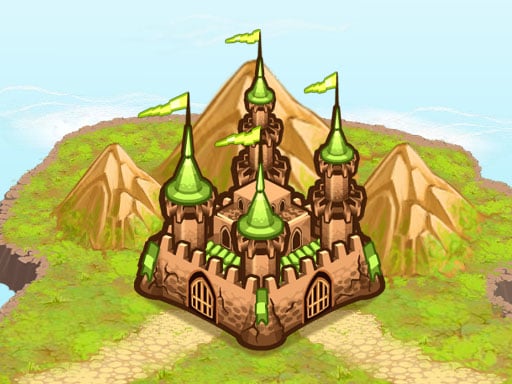
To learn how to grow a crowd on the way and arrive big enough for the castle, Castle Raid 3D is a good stop. Prefer multiplier gates over adding gates and keep a margin for the castle at the end.
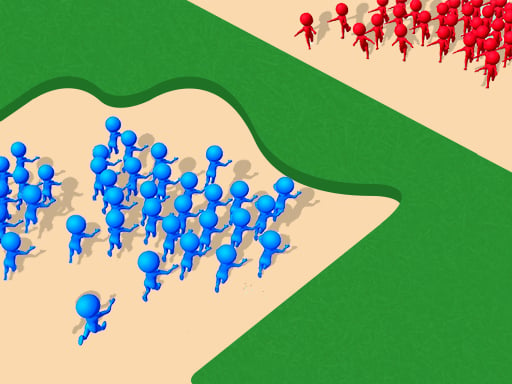
To practise a short front with a drawn line, try Territory.io and Paper.IO 2. Both work on a phone; the first shows a live share table at the top right, and in the second, when a rival cuts into your area, you head for their line instead of running.


For growth and survival in io arenas more broadly, read what io games are and how to play them; for holding a path against waves, see how to play tower defense. The wider genre is covered in the strategy games guide and the strategy category.
Frequently asked questions
Which building should I take first?
The closest empty or least populated one. It falls quickly, starts producing at once and does not stretch your front.
Why did my attack do nothing?
Most likely your flow did not beat the number in the target. Check it before you attack, and remember the target keeps producing while your troops are on the way.
Do these games work on a phone?
All six games in this article have touch controls. City Takeover and Castle Raid 3D are designed for a portrait screen.
What is the difference between building links and land grab?
With building links you send numbers, and a building is yours once you beat the count inside. In land grab you draw a trail and close it into your area; there are no numbers, but your trail is exposed while you are out.