The offline T-Rex game: jump timing, rising speed and longer runs
The dinosaur game is a one-button runner: the T-Rex runs to the right on its own, you jump over cacti and duck under the birds, and one touch of any obstacle ends the run. The way to a higher score is not pressing faster. It is pressing a little earlier as the game speeds up. Below are the rules step by step, then the timing, then the mistakes that end most runs.
If you have ever lost your Wi-Fi in Google Chrome, you have seen it: a small grey pixel T-Rex on the "No internet" page. Google added it to the browser in 2014, and it has been the default time killer for dropped connections ever since. It belongs to Google and it is not hosted here. What Oyun Köşesi does have is a handful of browser runners built on the same idea, and the last part of this guide says which one trains which skill.
The rules, step by step
- On the offline error page, press the space bar or the up arrow and the dinosaur starts running. On a phone, tap the dino.
- The T-Rex moves along a single lane from left to right. You never steer; you only control up and down.
- Space or the up arrow makes it jump. The longer you hold the key, the higher the jump.
- The down arrow makes it duck. Press it in mid-air and the dino drops straight back to the ground.
- Cacti come as singles, pairs or clusters of three. Further into the run, pterodactyls show up too, flying low, at head height or high above.
- Your score climbs with distance, and your best score sits in the top right corner.
- Touching anything ends the run. Press a key again and a fresh run starts instantly.
When to jump and when to duck
Everything comes down to one question: when do you press? The dino cannot change course in the air, and each jump lasts roughly the same time. Press too early and it starts falling before it clears the cactus, landing right on top of it. Press too late and you have already hit it. The safe window is when the cactus is about one body length away from the dinosaur.
Birds need a different decision. A low pterodactyl gets jumped. One flying at head height is best handled by holding the down arrow; jumping into it usually means flying straight into its wings. A high one is harmless, so do nothing and run underneath. Train yourself to read the height of the bird first and only then move your finger.
The down arrow has a second job: the fast drop. When a long jump is followed straight away by another cactus, tapping down in the air brings the dino back to earth early and buys time for the next jump. Strong scores lean heavily on this small move.
The speed-up: what a typical run looks like
The first few hundred points are easy. Obstacles are spread out and the dino is slow. Then the pace creeps up without any warning. A classic crash goes like this: you have pressed in the same rhythm for ages and it has worked every time. Then three cacti arrive in a row, you press at your usual moment, and because the game is faster now, your usual moment is too late. The T-Rex clips the third one.
The fix is to move your timing along with the speed instead of holding one fixed rhythm. As the run gets quicker, spot obstacles further out and start each jump a fraction sooner. Keep your eyes on the right edge of the screen where obstacles appear, not on the dinosaur itself. The earlier you see a cactus, the more time you have to decide.
Long runs also play with the colours: every so often the screen flips to a dark night mode and later back to day. The obstacles keep following the same rules, so do not let the colour change throw your timing off.
Habits that stretch your high score
- Keep taps short. A quick press gives a low, fast hop over a single cactus, so the dino lands sooner and is ready for what comes next.
- Hold a bit longer for a triple cluster. Clearing a wide group is about time in the air rather than height.
- Use the fast drop. Cutting the end of a jump short is the most useful move when obstacles come thick and fast.
- Judge birds by altitude: low means jump, head height means duck, high means wait.
- Play on a keyboard. Ducking is awkward to control on a touch screen, so for record attempts a keyboard is simply more comfortable.
Mistakes that end good runs
The most common one is holding the key all the way down on every obstacle. A full-height jump wastes time in the air, and you land unprepared for the next cactus. The second is sticking to your old rhythm after the speed has gone up. The game never announces that it is faster; adapting is your job.
Third, panicking at birds. Plenty of players see their first pterodactyl, jump on reflex and meet it exactly at its flying height. Fourth, button mashing: rapid clicking does not protect the dino, because a new jump cannot start while it is still airborne. And finally, staring at the screen instead of the obstacles when night mode kicks in has ended many promising runs.
Where to practise the same reflexes
The Chrome dinosaur only appears when you are offline or on the browser's own page. If you want to train the same jump timing while connected, Oyun Köşesi has similar runners that open straight in the browser. All of them are single player and work on phones as well.
Pixel Dino Run is the closest relative: a pixel-art dinosaur that jumps when you click or tap and speeds up as your points rise. Tapping again in the air drops it fast, which is exactly the move the down arrow does in Chrome. There is no ducking, so the whole challenge is jump timing.
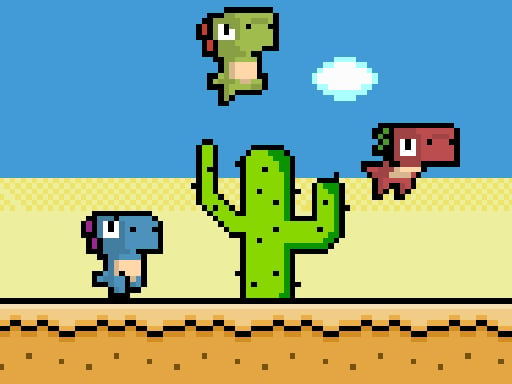
NEXRUN is another side-view endless runner with one-touch jumping. The twist is that the rewards along the track tend to sit at the top of a jump, so you practise clearing obstacles and being at the right height in the air at the same time.

Nibblix is the one where you feel the speed-up most clearly. A little dinosaur chases a mouse that gets quicker every time it eats cheese, and if you keep your old rhythm after each speed step, you crash. It is ideal for building the shift-your-timing habit described above.

Dino Run Game takes the theme into 3D. Besides jumping, you slide the dinosaur left and right with the arrow keys across narrow bridges and past rock obstacles. Think of it as the next step once the single-lane classic feels too easy.

For more, browse the running games category, or the animal games page for dinosaurs and other creatures. The bigger picture of the genre is in our running games guide.
Frequently asked questions
How do I play the dinosaur game while online?
Type chrome://dino into the Chrome address bar and the game page opens even with a working connection. It is the browser's own page, so it runs inside Chrome rather than on our site.
Does the dinosaur game ever end?
Not in practice. The speed stops rising at some point, but obstacles keep coming, so the goal is to beat your own best. NEXRUN works the same way: no finish line, only a record.
How do I get under the birds?
For a pterodactyl at head height, hold the down arrow until it has passed. Jump over the low ones and ignore the high ones.
Can I duck on a phone?
In Chrome on mobile the main move is tapping to jump; ducking is far less comfortable than the down arrow on a keyboard. That is why long record attempts go better on a computer. In our similar runners the touch controls are listed on each game page, and one-tap games like Nibblix play easily on a phone.