Calm recipe games your child can cook through one step at a time
If your child wants a cooking game, the easiest place to start is a recipe game: one dish, one worktop, and an arrow or icon that shows the next step. Roll out the dough, spread the sauce, slide it into the oven. There is no clock ticking and no queue of customers, and a mistake usually just means repeating that one step. Below you will find six recipe games grouped by age, a few ideas for playing them side by side, and some kitchen safety notes for the moment your child wants to cook for real.
Recipe games are not restaurant games
Cooking games split into two families. Restaurant games stack up order bubbles, drain patience bars and reward speed above everything; we cover how to survive them in restaurant games time management. Recipe games give the player a single plate and let them make it from start to finish. For a young child that difference matters a lot: one asks for hurry, the other for a calm routine.
In a recipe game the real task is order. Wash, then chop. Base first, then topping. Skip a step and nothing moves forward, so your child's eyes keep returning to the on-screen prompt. If you want the wider picture of the genre, our cooking games guide puts recipe, shop and factory games side by side.
Which game for which age?
We grouped these by how each game works: does it need reading, is the order fixed, and how far back does a mistake send you. The ages are a rough guide; you know your child best.
Ages 3 to 5: no reading, free to wander
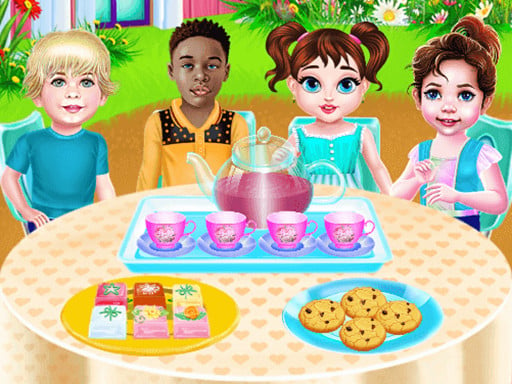
Baby Taylor Tea Party Day shows every step with icons, so nobody needs to read. Your child boils the water, fills the teapot, bakes little cakes, pipes cream on top and lines them up on a tray. When the guests arrive, refilling cups and handing out plates is their job too. It is a short story of a few levels, so it fits into one sitting.
Rainbow Ice Cream And Popsicles is relaxed for this age because the levels are not linked. Cones, ice lollies or soft serve: your child picks from the menu, and can switch to another any time. Decorating with sauce and sprinkles tends to be the favourite part. For more frozen treats, the ice cream and drinks games page collects similar titles.

Ages 5 to 7: following a sequence
Blend It Perfect has your child slice fruit with a swipe, then hold down to run the blender. The last step is filling the glass without spilling, which means lifting the finger just as the juice nears the line. The game itself says plainly that its steps are simplified and give no real quantities, so enjoy it as a game.

Cooking Lunch At School walks through a burger, a fresh salad and fried chicken. An arrow always points at the next step. The text is in English, but the prompts are visual, so a child who cannot read yet still follows along. In the salad, unwashed vegetables will not go onto the chopping board.

Ages 7 and up: patience and attention
The Best Pizza unlocks six pizza recipes one after another. The sauce has to reach the edges, toppings go on in the order shown on the recipe card, and the oven gauge needs watching: pull the pizza out early and the dough is raw, leave it too long and it burns, and the recipe starts again. There are no customers waiting, but the oven asks for patience.

Cheese Cake Homemade Cooking starts in the supermarket. Your child collects what is on the shopping list, pays, cleans the worktop, crushes the biscuit base and presses it into the tin, then bakes the cake. Then comes the hard part: waiting for it to cool before decorating. Steps cannot be skipped. The cake making games page is a good next stop for more bakes.

Playing together: read the recipe out loud
Sit next to your child for the first round and say each step together. What comes next? Which ingredient is missing? How full is the oven gauge? Then hand over the mouse or tablet and only ask questions. If something burns, hold back for a moment. In this kind of game, starting a recipe again is not a punishment, just another try.
Comparing the game with your own kitchen makes for an easy chat. What goes on the pizza you make on Friday nights? How do you make a cup of tea at home? A real cheesecake sits in the fridge for hours before anyone can decorate it, while the game takes a few minutes. Talking about that gap links the game to real life without replacing it.
Moving to the real kitchen: a safety note
Sooner or later your child will want to cook for real. A real kitchen is far less forgiving than a screen, so a few ground rules:
- An adult stays in the kitchen the whole time; a child never cooks alone.
- Knives, the hob, the oven and the blender are grown-up jobs. Give your child washing, stirring, arranging and decorating.
- Everyone washes their hands first, and hot pans stay at the back of the worktop, handles turned inward.
- The times and amounts in these games are not real. Take your recipe from a cookbook or another source you trust.
Ads, language and screen time
These games come from an outside provider, so ads can appear inside the game window. Staying close during the first sessions stops a small child tapping an ad by accident. None of them asks for a download or an account; close the tab and the game is gone. A few menus are in English, but all six move forward through pictures. For time limits, agreeing on a number of recipes tends to work better than counting minutes: two recipes, then we stop. For a broader look, read screen time and gaming balance.
Parent checklist
- Choose a recipe game, not a restaurant game, so there is no timer.
- With a younger child, start with a game that needs no reading and has free levels.
- Cook the first recipe together and say each step out loud.
- Agree on the finish line as a number of recipes.
- In a real kitchen, knives, hob and oven stay with the adult.
You will find every recipe game in our cooking games section, and more calm options for little ones under kids games.
Frequently asked questions
From what age are these games suitable?
The tea party and ice cream games need no reading and let your child move freely between levels, so with an adult nearby they work from around three. The ones with an oven gauge or a fixed order suit slightly older children. What decides it is less the age than how patient your child stays after a mistake.
Can we cook the recipes from the games at home?
Not directly. The games simplify each step and give no real amounts or cooking times. They are a nice way to talk about which ingredient goes in when, but the recipe you actually cook should come from a real source.
Do they work on a phone or tablet?
All six can be played with a finger on a touch screen. On a computer, clicking and dragging with the mouse is enough, and no keyboard is needed.